Revolution of Art- the 1700’s
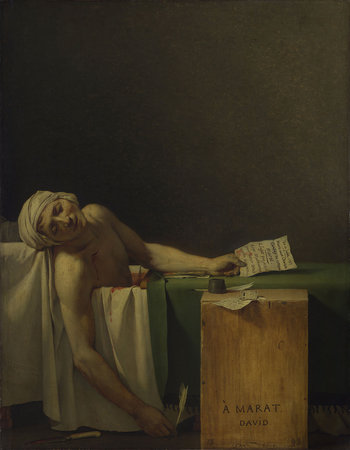
The Death of Marat, created in 1792 by Jacques-Luis David is located in the Royal Museum of Fine Arts, Brussels. This piece stood out to me because of the use of linear strokes and the message Jacques sent to his audience about the violence of the French Revolution. The influence of the American Revolution, leading into the French Revolution, is rebellion and the rise of self-governance. This is a key component to the Revolution of Art in the 1700’s. This is one of the most powerful pieces from the French Revolution, and the image includes revolutionary leader Jean-Paul Marat. Beheadings were constant at the Place de la Concorde in Paris, and new ways to behead people were a work in progress by Dr. Joseph Guillotine with the intention to make them more “humane”. Jacques was a part of the Jacobins, one of the most rebellious groups which included Georges Danton and Maximilien Robespierre. In time they voted to have Louis XVI and his Queen Marie Antoinette executed. David used his talent to give revolutionary leaders a voice, like Jean-Paul Marat. The style of painting is a strong example of Neoclassicism with the heroic male nude, drama, and the contrast between light and dark lighting. I have always enjoyed Neoclassical artwork from this time, because of the drama and the contrast used with the subjects. The messages are clearer for me, in comparison to other styles of artwork like the Rococo style of artwork.
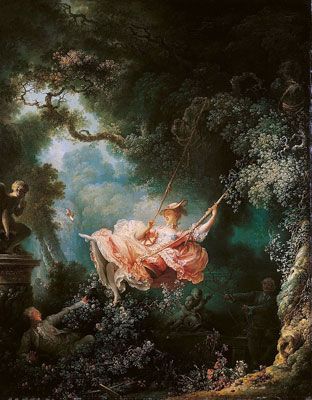
The Swing, by Jean-Honoré Fragonard is an oil-on canvas Rococo style painting and is a piece of the Collection of Wallace, located in London, United Kingdom made in 1767. The painting includes mistress of the Baron de Saint-Julien, with her husband pushing her. At first glance, it looks like a beautiful, innocent moment. Upon further reflection, I noticed the man on the other side of the swing and the man that is looking up the mistress’s skirt. I chose this painting because it is also risqué and rebellious, but in a completely different way in comparison to The Death of Marat. A history painter named Doyen, was originally asked to make this painting by an “unnamed person” who wanted a painting of his mistress in a swing with him hiding in the bushes and a bishop pushing her from the other side. Doyen found this request a bit too scandalous, so they passed it to Jean-Honoré Fragonard to create and commission. This piece sends a message that society already knew during this time period, and that is that in the French eighteenth-century society men were allowed mistresses, but women had to be secretive about their lovers. They had to provide their husband with a male heir first, and hide any affairs outside of their marriages. This painting reflects what some women were doing, despite the limitations society had on them. It is rebellious, in it’s own way it is influenced by the French Revolution as well and the rise of self-governance in society. Although the message seems more subtle at first glance, this piece was a form of expression that wasn’t the societal norm at the time. Therefor, it is an important piece to the Revolution of Art in the 1700’s. The French RevoIution created many interesting subject matters for all artists, including this one. Rococo art seems to be more complex and equally as beautiful as Neoclassical, but that is only my opinion and experience. I also enjoyed learning about the rise and fall of a King and Emperor set to “Viva La Vida” in the YouTube video about the French Revolution, thank you.
The unique aspect of Rococo art that catches my eye is the gliding commonly used in pieces, theatrical style, beautiful pastel colors, and trompe l’oeil frescoes to create surprise and the illusion of motion and drama. The Swing is a great example of all those things, including the pastel color of the girls dress, the movement of the swing gliding, naturalism, the theatrics of all the subjects in the painting, unaware of each other’s existence, and the illusion of motion and drama with the lovers and the motion of the swing. I loved the aesthetic of this piece, it was fun to learn about.
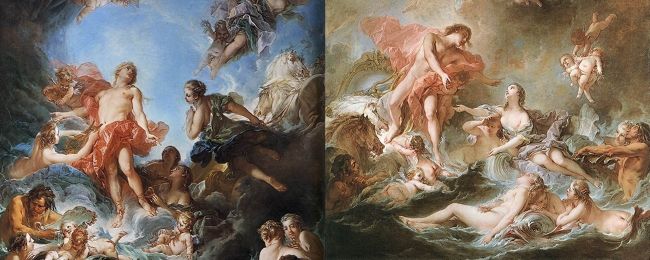
The Rising of the Sun and Setting of the Sun by Francois Boucher is oil painted on canvas in 1752, in the Wallace Collection, located in London. They were commissioned by Madame de Pompadour for tapestries to be hung in the bedroom of King Louis XV. This is a beautiful example of Rococo style of painting, with the gliding of the subject and the pastel colors. There is theatrics and drama included in the placement of the nude subjects as well. The decorative nature of this piece is a great example of Rococo art, considering it was meant to be a tapestry.
The use of symbolism with the mythology Apollo ascends into the sky with arms outstretched, chasing darkness symbolizes the influence of the authority of the monarchy at this time. The influence of the authority of the monarchy during the French Revolution is expressed in this piece, through the struggle of the lower class and the power of the monarchy ascending above them. This is an important piece of the Revolution of Art during the 1700’s, because of the message Francois Boucher is sending to society about the power of the monarchy during the 1752. The aesthetic of this piece is powerful, with the use of Greek Mythology and the theatrics used. I wouldn’t use it as a tapestry, but I would like a copy in a book of artwork from Francois Boucher.
Bibliography
https://www.theartstory.org/artist/boucher-francois/artworks/
 Indigenous Voice