Introduction
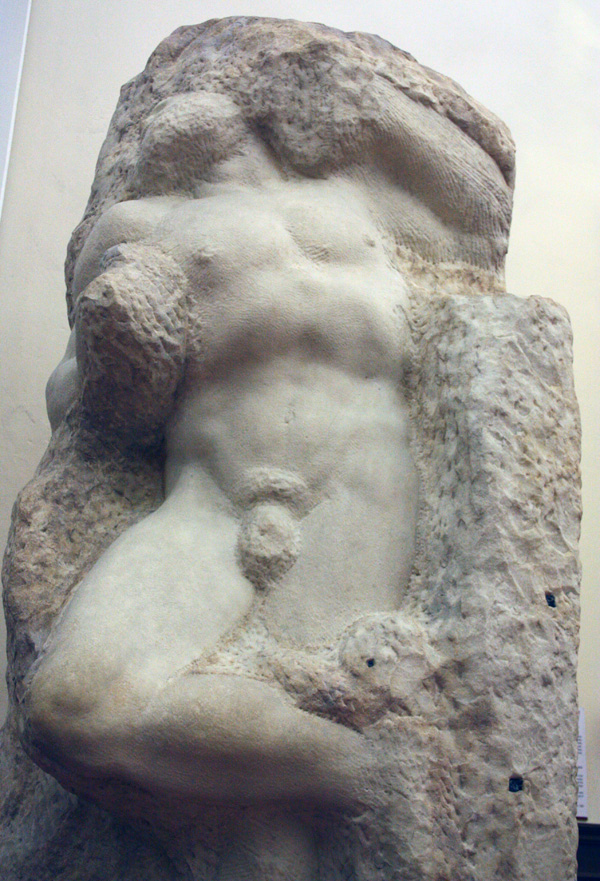
Michelangelo was commissioned to create sculptures for Pope Julius II. Pope Julius II was one of the many people impressed by Michelangelo’s sculpture of David (1501-04), which is located in Florence. Michelangelo created a series six sculptures of slaves for Pope Julius II, Atlas (1519), the Awakening Slave (1530-1533), the Young Slave (1530-1533), and the Bearded Slave (1530-1533), and the Rebellious Slave (1530-1533). The Awakening Slave is the one I will be discussing today.
Pope Julius II
These sculptures are all made of Carrara marble, and were commissioned for the tomb of Pope Julius II. Pope Julius II was highly ambitious with his plan for his tomb. He originally asked for 40 sculptures of slaves to surround a sculpture of Moses (1515), and the pope himself. The finished, or nearly finished sculptures are located in St. Peter’s, in Rome. Michelangelo was supposed to carve and build 40 sculptures to surround Moses in the tomb at the Basilica of St. Peter’s, but Pop Julius II did not have the funds to pay Michelangelo to finish this project. Michelangelo was also having trouble finding the Carrara marble needed to continue creating these sculptures. There are also theories that state that he lost interest in this project. These sculptures were left unfinished and set aside. Instead of finishing these sculptures, Michelangelo started his work with the painting the ceiling of the Sistine Chapel. The tomb was redesigned to fit the slaves with Moses. The sculptures were not named by Michelangelo, and instead they were named by other people’s interpretation of the sculptures.
Opinion
I chose the Awakening Slave sculpture in particular, because although it is the least outlined out of the four sculptures, it is extremely powerful. If not, the most powerful because it is unfinished. The figure that is carved into the marble seems to be struggling. The figure is struggling to explode from the marble that is keeping the figure contained. Looking at the body language of the slave, in it’s unnatural state, shows us how uncomfortable it is and how much effort they are putting in to escape the marble. Looking at the Awakening Slave, I feel sorry for the sculpture. Even though it is a sculpture made of clay, I want to help the person that is carved into the marble. I think this sculpture was created to demonstrate a slave trying to liberate themselves from the marble that is keeping them hostage. Michelangelo intended to leave the clay so that the sculpture is seen as struggling out of the marble. His unfinished sculptures are very expressive with the need to escape. I think he intended to send this message for the slaves, although it could just be unfinished work. These slaves that he sculpted had natural, imperfect bodies. He outlined each figure with distinctive lines and body language portraying the need to escape. It’s difficult to imagine these sculptures as just a block of marble, because of how Michelangelo transformed the marble.
Whether or not Michelangelo intended on presenting these sculptures as unfinished, they sent a clear message to the audience for their need to escape the clay. One of the interpretations of these sculptures is that Michelangelo wanted to represent the arts at this time, such as painting, architecture, and sculpture. Since Michelangelo was building and sculpting these slaves for Pope Julius II for his future death, he could have been trying to mourn the loss of freedom Pope Julius II was known for fighting for, against the churches. Pope Julius II was well known for being a warrior and activist for the arts. I think that Michelangelo was influenced by the activists, such as Pope Julius II for the arts. I think he used these slaves to communicate the agony of the arts that could come from Pope Julis II’s death.
Bibliography
“Awakening Slave.” Awakening Slave by Michelangelo, www.michelangelo.net/awakening-slave/.
“Michelangelo’s Prisoners or Slaves at the Accademia Gallery.” Guide to Accademia Gallery, .http://www.accademia.org/explore-museum/artworks/michelangelos-prisoners-slaves/.
Hansen, Paul. “Hansen.” Michaelangelo’s Slaves – Paper by Paul Hansen, www.people.vcu.edu/~djbromle/artviewsnet/portrait04/paul/slavesbymichelangelo.htm.
 Indigenous Voice
This is so amazing the detail in this rock, its make me wonder it the artist made a mistake if they just make it a part of their work, or do they sketch their idea out first. I also wonder if its similar process to our ice carving except id imagine a little more slow. Over all a great piece of art.
LikeLike
Even though it is much less defined than most sculptures of the Renaissance, it holds a lot of emotion. Look at the body posture for instance, Michelangelo’s skill is unmatched. He shows that time and time again with this plus many other works of art. How much agony did he imagine the slave in the sculpture to have? I can imagine quite a bit!
LikeLike
For me, in general, it makes me uncomfortable to see things unfinished. But this sculpture has an exception for me because of the reason behind it. Personally, I feel like I’m struggling the most sometimes, and lately, I have been. Whenever I go and look at that sculpture in the above photo, I can’t help but feel like I’m also suffocating.
LikeLike