Caravaggio
Introduction
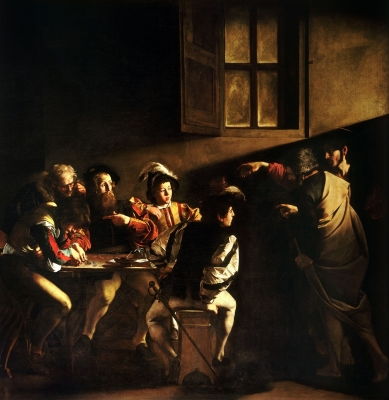
Caravaggio’s The Calling of St. Mathew, was a moment captured in time of Spiritual Awakening. St. Mathew was one of Jesus’s apostles and this is one of three works of art explaining his journey. This moment that you see here, is the moment that inspired St. Mathew to follow Jesus Christ. It was finished in 1599-1600 and it was originally made for The Contarelli Chapel in the church of the French congregation in Rome. The medium that was used was oil on canvas.
Matthew 9:9: “And when Jesus passed on from thence, he saw a man sitting in the custom house, named Matthew; and he said to him: Follow me. And he arose up and followed him.”
https://www.artble.com/artists/caravaggio/paintings/the_calling_of_saint_matthew
Caravaggio
Michelangelo Merisi da Caravaggio (1571-1610) work of art The Calling of St. Mathew, is a key moment in time because this was the start of Caravaggio’s career as one of the most well known painters in Rome. He was commissioned by This painting tells a piece of a story of the biblical story of Jesus asking Mathew, a tax collector to be one of his disciples. He is wearing a black hat and Mathew has a full, red beard. This piece of art surprised the Roman public because of the new style of and simplicity of the oil on canvas, life-size painting. He painted religious subjects and he was seen as a rebel in Rome’s society. He was not fond of mannerism, and he favored natural forms and figures opposed to idealistic forms and figures. Even saints, like Jesus were painted as ordinary people. The usual influence of royalty is not present in this painting, because everyone is painted as normal individuals.
This moment of transition is captured by the lighting used in the painting, for example, the light that is shining on the faces. This creates drama that is new and exciting to the Baroque era. The light is streaming in, and Christ is pointing to Mathew. Mathew looks confused, pointing to himself in question. The setting is in a bar, and Mathew is in the middle of counting the taxes that he has collected. The hand of Christ is reaching out to Mathew, asking him to follow him. The style that Caravaggio uses is naturalistic, and dramatic with the contrast between the light and dark subjects. His figures look like common people, in a common setting, a bar. The use of chiaroscuro, or tenebrism in this piece creates the drama needed for a piece of art that is presented as a spiritual awakening.
This was a turn of the Renassiance idealism and it challenged the old ways of viewing art. The use of darkness and lighting is very important, because it was unusual in this time period. The people are painted in a natural style, not in an idealistic way. There is different theories to who Jesus is actually pointing to, and who are the other people sitting at the table. The only people that have been identified is Mathew, with the red beard, Jesus who is pointing, and Peter, who is standing next to Jesus. This piece is appropriately called a spiritual awakening, because Caravaggio took a chance with challenging the Mannerist style with his naturalistic approach.
Opinion
I have always enjoyed contrast when it comes to paintings- So I enjoyed this one. Learning about Caravaggio and his invention of tenebrism was interesting, too. This time period is exciting because of how dramatic the art became, which to me is like a breath of fresh air. The paintings and intentions are clearer in comparison to the Northern Renaissance era. The power of the contrast draws me in and I’m more inclined to understand what is going on. I love that Caravaggio is challenging the Mannerist approach and creating his own style. The inspiration that this piece drew is also exciting- because it really was a spiritual awakening for the arts. There is raw, dramatic emotion that is presented in Caravaggio’s style. As a viewer, this art feels more familiar because although it is dramatic the subjects and individuals are painted in a natural way. It is more relatable as a viewer, with a stronger presentation that will draw you in regardless of your religious affiliation.


I did my post on one of Caravaggio’s pieces as well! I noticed some similar things as you, such as the plainly dressed Jesus the characterization of the normal people of europe rather than the portrayal of the wealthy or noble. Caravaggio’s style of painting dramatic light to emphasize certain points is really cool too. In this piece the light is at Jesus’ back which allows the viewer to see that, to Mathew, that light is blinding and appears to appear from Jesus. The dark room further emphasizes that. Awesome work!
LikeLike
I covered Gerrit Dou’s “The Night School”, which had a similar emphasis on the use of lights and shadows. I love how the light just barely brushes Jesus, while highlighting Matthew. It’s a beautiful way to show the focus and story of the piece. Light is used in so many unique ways across artists in this era: a holy presence, the light of wisdom, tension between groups. It’s one of my favorite “characters” in art, and it’s a major highlight of this whole era!
It looks like your sentence about the commissioner got snipped off at the end. Which is really unfortunate considering how interesting it was. Cardinal Matteo Contarelli wanted to have paintings themed around his namesake (St. Michael) hung in his chapel. He left funding and instructions on decorating the Contarelli Chapel in his will. The chapel’s dome was painted by Cavalier D’Arpino, but he was busy with work from the royalty and papacy when the St. Maichael set was finally commissioned. Caravaggio’s patron, one Cardinal Francesco Del Monte, noticed the job and pulled a few strings for Caravaggio to get his first major church job.
LikeLike
I have to admit this is my least favorite of the paintings I have seen by Carravaggio. Not because it is not beautiful, but because it seems less clear to me. If I did not know the title was “The Calling of St. Matthew” I would have thought it to be a bunch of people “merchants” in a pub. I do very much like the dress he placed on the characters but they seem to similar to each other. Basically, I get lost in the painting. I did very much like your blog and how you explained the history. I have become very interested in the life of Caravaggio.
LikeLike