The Influence of African Americans
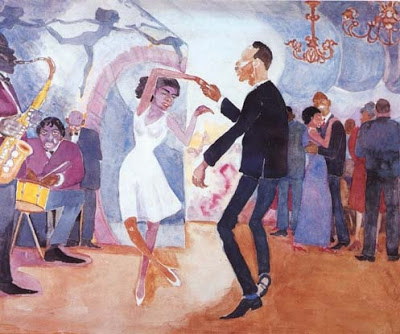
Jeunesse, painted by Palmer Hayden is definitely my favorite piece I have found so far. The date and location of this piece is unknown, but it was painted with watercolor on paper. It is powerful and stunning at the same time. The message that I received when I saw this painting for the first time was that this painting represented the reformation and excitement in African American culture during the explosion of culture in Harlem between the end of World War I and the middle of the 1930s. . As more African Americans moved to Harlem for the Great Migration, it became one of the most well-known spots for African American culture. Music, jazz, dance, poetry, artwork, thrived and became popular to white audiences.
The name Jeunesse could be interpreted for Jeune, or youth, in French. This name could resemble the new age of culture and enlightenment during this time for African Americans. If you look at the use of lighting in the painting, the young couple is in the spotlight of natural light and their movements are free and fluid. Looking at the people in the back, you can see they are not painted with as much light and their movements are not as open and fluid. The focus is the couple dancing to live jazz music and expressing themselves freely. I believe this is a beautiful depiction of the cultural boost of the Harlem Renassiance and a stunning example of the African American culture. The use of pastel colors, lighting, and movement make it an uplifting and calming piece. I would put this in my living room, somewhere where it would also get a lot of light and attention. The energy that I get from this painting is full of freedom, excitement, and ethnic pride. This piece is a special moment within the fight of oppression and Palmer Hayden communicated the story behind this painting very well. Some people also believe that this painting, as well as the name was also a depiction of Juneteenth and the freedom from slavery. This piece translated the influence of African Americans and their cultural freedoms with music, and dance beautifully through this painting. There is so much freedom, love, and pride in this piece. I could stare at it everyday.
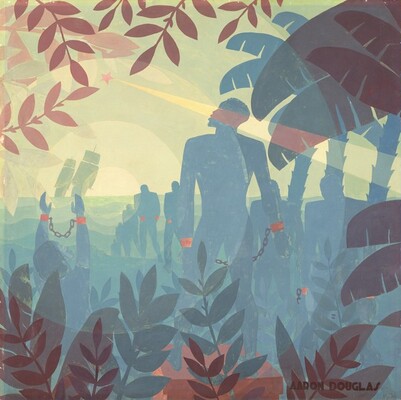
Into Bondage, by Aaron Douglas was created in 1936 with oil on canvas. I chose this piece because although it shows a heartbreaking, grim image of African American’s bound and enslaved for America- there is still hope. Aaron Douglas was considered a leader of the Harlem Renaissance, because of his ability to create artwork filled with pride and inspiration for African American culture, which had a powerful impact on the influence of African Americans on society. The figures in the distance are hanging their heads low, with chains on their hands.
The oppression is painted so clearly in this piece, with the body language of the figures as they are keeping their heads low, yet there is still so much hope with the woman holding up her hands towards the ship in the distance. The figure closets to the viewers eye is raising his head in optimism at where the woman is pointing and raising her hands. The use of lighting from the sun shining illuminates the hope for freedom for the future. Douglas used concentric circles in his paintings to communicate sound, specifically African American songs within his painting. This detail translates into an echoing effect, at least to me. It looks like an echo of hope and freedom is coming from the horizon. Even though this is a specific moment in time, there is still movement with the figures walking and the woman holding up her hands. I would love to have this piece in my home, maybe in a collage in my living room. The use of pastels and lighting creates a slightly sad, calm, inspiring piece with a powerful message and story. I think I’m starting to see a pattern for my love of paintings that incorporate pastels.
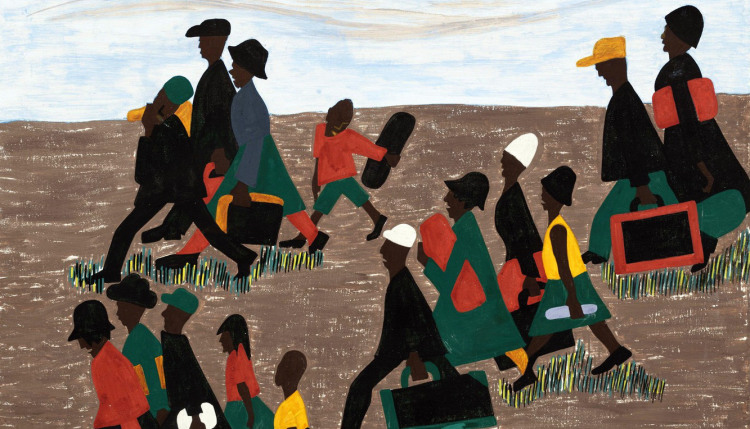
The Great Migration by Jacob Lawrence in the 1930’s is 60 panels painted casein tempera on hardboard. This series tells the story of the Great Migratation which was the mass movement of over one million African Americans. They fled from the rural South to the North from the failing cotton community, which was a monumental movement that changed our social, economic, political and cultural future. The demand for labor after World War I drove African Americans in massive numbers to major industrial centers of the North, such as Chicago, Detroit, Cleveland, St. Louis, Pittsburgh, Philadelphia, and New York City. Jacob Lawrence is one of the most well known artists of all time. His use of vivid colors with set against black and brown figures. He made a difference by telling a unified story throughout his series, like The Great Migration. He worked on all the pieces at the same time, so that they had a unified feel to the viewers. His paintings are told as a narrative, a moment in time but they all work together to tell the story of the drive and demand for labor after World War I. This translates into the influence of African Americans, because Jacob Lawrence was able to tell a clear narrative to society with vivid colors and clear intentions from the Great Migration in pursuit of the North.
I would love to add these pieces to a collage in a hallway. I would like them to tell the narrative that Jacob Lawrence intended them to have and it would be neat to be able to walk past them as the viewers consume the story of The Great Migration. The use of vivid colors is eye-catching and the movement included in the pieces is easily translated, at least for me. The message I get from these pieces is inspiring because of the drive the mass crowds of people have in pursuit to a better quality of life, despite their hardships in the past. I don’t want to speak too soon, but The Early Modern Era of artwork has been a favorite for sure.
Bibliography
http://“Into Bondage.” Art Object Page, www.nga.gov/collection/art-object-page.166444.html.
 Indigenous Voice
We chose the same artists for our assignment! I adore Jeunesse! The fluidity of the dancer’s motion with the silhouettes on the back wall creates such a notion of motion. I think the band’s inclusion is really important because it allows the fusion of dance and music. The people on the right may represent those who feel uncomfortable with such rambunctious dancing at the front showing different levels of self expression. I liked your comment about the echo of hope, I think that was a very astute observation. I think you’ve related all the works and shown the powerful African American impact that was made in this period.
LikeLike
I love how you saw the excitement in the painting of the dancers. The viewer gets a feeling of hope and life. This expresses the feeling of the time. The youth-related name implies that the new era of the Harlem Renaissance was in its early stage, or youth.
I also chose an Aaron Douglas image for my blog assignment. I like the one you picked. The shapes are bold, and the figures postures show the emotional depth of the painting. I noticed right away that the woman’s shackles were red. This was eye-catching against the mostly greenish-blue background. We understand how important this element of the painting was to the artist.
The Migration painting shows the hope the people moving from South to North felt as they left behind the terrible conditions. The viewer can imagine how hopeful those people must have felt as they walked toward a better life. I especially liked the boy in the center jauntily swinging his suitcase. This shows the lighthearted mood of these travelers.
LikeLike
The Harlem Renaissance was full of such rich culture and resulted in some truly incredible, powerful pieces, and I think your blog post really embraces that. With the first piece you showcased, I looked at one very similar. It highlights a couple dancing to the live music, they look so happy. I too, think this demonstrates the rebirth of African American culture due to the Harlem Renaissance. The second piece, I personally see to be breathtaking, it is so powerful. As you noticed, my favorite aspect is that man and woman, despite being bound by chains, have their heads high. It represents strength and hope. The third piece is so vibrant with all the colors, I also like that the people’s shadows are this colorful pattern. I think that demonstrates that wherever their people may go, their culture follows. Thank you for your analysis of these pieces, and a great blog post!
LikeLike
First off got to say I love that first painting, it’s great and your analysis on it also amazing. It’s one of those pieces you can just instantly imagine the scene being portrayed being played out. Although I will also say your other choices are great ones to see. I also think your analysis and explanation on the stories of each piece is very well done, especially the story on the last piece was especially interesting to me.
LikeLike